
Play Sizzling Hot Now!
Home → Strategy
Sizzling Hot Strategy
Approaching Sizzling Hot sensibly
Sizzling Hot is an online slot developed by Novomatic that launched in 2003 with a specific mathematical structure. The theoretical return to player stands at 95.66%, which establishes a house edge of 4.34% over extended play sessions. This percentage indicates the expected loss rate per euro wagered, guiding players on long-term bankroll management strategies for this classic fruit-themed title.
Alternative operator builds circulate with lower RTP configurations of 92.28% and 90.02%, creating significant variance in potential returns compared to the standard version. Players must verify the exact build before playing, as the difference between 95.66% and 90.02% drastically alters the expected value of every spin placed. Choosing the higher RTP variant preserves more capital during the session.
Bankroll rules that hold up
The maximum win cap for Sizzling Hot is set at 5000x the total bet amount, defining the absolute ceiling for any single payout event. This multiplier applies across the five paylines and requires landing high-value symbols like red Sevens or Star Scatters to trigger the top prize tier. Knowing this limit helps players set realistic expectations regarding the volatility of their returns during gameplay.
Bet sizing against volatility
Sizzling Hot features medium volatility, meaning wins occur with moderate frequency and size, balancing risk against reward throughout the gaming session. This characteristic suggests that flat betting strategies may be more sustainable than progressive staking methods that raise stakes after losses. The medium variance ensures that bankroll depletion happens slower than in high-volatility slots, allowing for longer engagement with the same funds.
Session limits worth setting
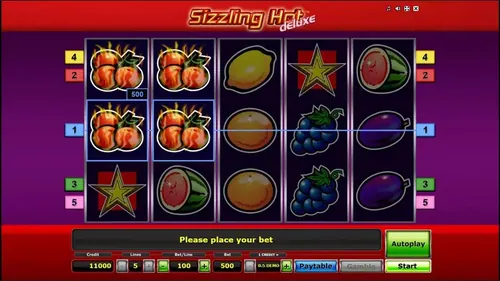
The game utilizes a 5x3 reel layout with exactly five fixed paylines, providing a straightforward structure for tracking winning combinations and losses. Each spin evaluates these five lines simultaneously, requiring bets on all active paths to qualify for any potential payout from the fruit symbols. This fixed configuration simplifies budget calculations since the cost per round remains constant regardless of symbol placement.
Why chasing losses fails
Sizzling Hot includes a Gamble feature but explicitly lacks wild symbols and free spins rounds, limiting opportunities for rapid bonus accumulation. Without these common modern features, the base game relies entirely on the 95.66% RTP for returns, making it difficult to recover losses quickly through complex mechanics. Players should recognize that the absence of free spins reduces the potential for large, unexpected windfalls that might justify risky behavior.
Sizzling Hot: key facts
| Parameter | Value |
|---|---|
| Game | Sizzling Hot |
| Studio | Novomatic |
| Released | 2003 |
| RTP | 95.66% |
| House edge | 4.34% |
| Volatility | medium |
| Max win | 5000x |
| Reels | 5x3 |
| Paylines / ways | 5 lines |
Common systems and their limits
The Sizzling Hot slot from Novomatic operates on a fixed 5-line structure with a theoretical RTP of 95.66%, which establishes a constant house edge of 4.34%. This mathematical baseline remains unchanged regardless of betting patterns or symbol sequences, meaning no strategy can alter the long-term expected loss. Players must accept that every spin contributes to this fixed percentage rather than offering a path to overcome the built-in advantage.
Alternative operator builds for this title circulate with lower RTP figures such as 92.28% and 90.02%, significantly increasing the house edge compared to the standard configuration. These variations demonstrate that game providers like Novomatic can adjust return parameters, directly impacting player bankroll longevity without changing core mechanics. A lower return percentage accelerates bankroll depletion, making the specific version played a critical factor in session planning.
Unlike Indian Spirit, which also features Novomatic development but carries an RTP of 95.34%, the Sizzling Hot variant offers slightly better theoretical returns in its primary form. Comparing these two titles highlights how minor decimal differences accumulate over thousands of spins to affect total payout potential. The absence of wild symbols or free spins in Sizzling Hot further restricts variance management options available to the player.
Flat betting explained
Flat betting involves wagering the same stake amount on every single round, maintaining a consistent risk profile throughout the gaming session. For Sizzling Hot, this approach prevents rapid bankroll exhaustion that often results from chasing losses with escalating bets. By keeping the bet size static, players extend their playtime and reduce the volatility impact on their total deposit.
The maximum win cap of 5000x provides a clear upper limit on potential payouts, regardless of whether the player employs flat betting or progressive strategies. Since the game lacks wild symbols, achieving high-value combinations relies entirely on random alignment across the five paylines. This constraint means flat betting does not hinder the ability to hit the top prize, though it does not increase the probability of doing so.
Using a fixed stake ensures that the house edge of 4.34% applies uniformly to every euro wagered, simplifying loss tracking and budget management. Unlike progressive systems that distort risk exposure, flat betting preserves the original statistical expectations defined by the 95.66% RTP. This method aligns best with the medium volatility design, allowing players to withstand dry spells without significant financial strain.
Progressive staking risks
Progressive staking raises stakes after losses in an attempt to recover previous deficits, a tactic that fundamentally increases exposure to the house edge. In Sizzling Hot, where the maximum win is capped at 5000x, escalating bets do not improve the odds of hitting that ceiling but rather accelerate bankroll erosion. The mathematical expectation remains negative, meaning larger bets only shorten the duration of play before ruin occurs.
The absence of free spins and wild symbols in Sizzling Hot means there are no bonus features to mitigate the damage caused by aggressive betting progressions. Unlike games with complex multiplier chains, the fruit-based layout offers limited opportunities for large wins during base gameplay. Raising stakes after losses ignores this structural limitation, turning moderate volatility into severe financial risk.
Comparing this risk profile to Indian Spirit, which shares similar Novomatic roots but different volatility characteristics, reveals that progressive systems fail across all slot types. The 95.34% RTP of Indian Spirit still imposes a house edge that no staking adjustment can overcome. For Sizzling Hot, using progressive methods against a 4.34% edge guarantees faster depletion of the player's funds compared to conservative flat betting.
What the maths actually allows
The theoretical RTP of 95.66% indicates that for every 100 units wagered, the game returns approximately 95.66 units over an extended period. This figure represents a long-run average derived from hundreds of thousands of spins, not a guarantee for individual sessions or short playing times. Players should view this percentage as a statistical boundary rather than a predictable outcome for any single visit.
Medium volatility in Sizzling Hot balances the frequency of wins with their size, avoiding extreme swings while still offering substantial payouts up to the 5000x cap. This design complements the 5-line structure by providing regular small-to-medium returns that sustain gameplay between larger hits. Understanding this balance helps players set realistic expectations for session length and potential drawdowns.
The Gamble feature offers an additional mechanic where players can risk winnings for higher rewards, but it does not alter the underlying 95.66% RTP of the base game. Using this feature increases variance without improving the overall return percentage, effectively transferring risk from the house to the player temporarily. Mathematically, relying on the gamble feature adds another layer of negative expectation to an already disadvantageous game structure.
Reading variance honestly
Sizzling Hot’s medium volatility classification suggests a moderate level of risk, where win frequency and size are balanced to prevent extreme bankroll fluctuations. The 5x3 reel layout with 5 paylines creates a straightforward winning pattern that avoids the complexity found in modern video slots. This simplicity allows players to clearly track their performance against the stated 95.66% RTP without confusion from hidden mechanics.
The maximum win of 5000x serves as the highest possible payout threshold, limiting the upside potential despite the attractive fruit theme. Since there are no wild symbols to substitute for other icons, achieving this cap requires precise alignment of high-value symbols like red Sevens or Stars. This constraint makes the 5000x win a rare event, reinforcing the importance of managing expectations around hit frequency.
Alternative RTP versions with 92.28% or 90.02% introduce higher variance in terms of expected loss, even if the visual gameplay remains identical. These configurations shift more money back to the operator, reducing the effective bankroll longevity for the player. Recognizing which version is active is crucial, as the difference between 95.66% and 90.02% represents a significant increase in the house edge that impacts long-term results.
Learning the game in demo first
The developer Novomatic released Sizzling Hot in 2003, establishing a classic five-reel framework that remains popular today. This vintage title features a straightforward layout with five paylines and medium volatility, offering players a balanced risk profile for extended sessions. Understanding these core mechanics before wagering real money helps new users navigate the specific symbol interactions without financial pressure.
Sizzling Hot utilizes a theoretical return of 95.66% over very long runs, which implies a house edge of 4.34% for every euro wagered. Alternative operator builds circulate with lower returns like 92.28% or 90.02%, making it crucial to verify the specific version being played. Checking these percentages ensures you know exactly how much the casino retains from your total betting volume over time.
The maximum win potential in this slot is capped at 5000x your stake, providing a clear target for high-risk gameplay strategies. Unlike modern video slots, Sizzling Hot lacks wild symbols and free spin bonuses, relying instead on classic fruit symbols and red Sevens. Players seeking complex bonus rounds might prefer Alles Spitze by Merkur, which offers a different feature set despite its own limitations.
Adjusting stakes to your budget
Flat betting involves keeping the same stake every round, which helps preserve your bankroll during the medium volatility swings of Sizzling Hot. Progressive staking raises stakes after losses, but this strategy does not change the built-in 4.34% house edge and only shortens your time to ruin. Maintaining a consistent bet size allows for more predictable loss rates when playing against the fixed RTP of 95.66%.
The game operates on a 5x3 reel layout with five lines, requiring bets that align with your total available funds rather than chasing big wins. A standard session might involve hundreds of spins, where the cumulative effect of the 4.34% edge slowly erodes the initial deposit. Setting a daily limit based on the maximum win cap of 5000x ensures you do not exceed your intended spending threshold.
Novomatic designed Sizzling Hot to accommodate various bankroll sizes through its flexible line structure, though no minimum stake is explicitly listed here. Comparing this to Alles Spitze, which has a high volatility rating and a much lower max win of 500x, highlights the difference in payout frequency. Choosing the right stake level depends on whether you prioritize frequent small wins or rare large payouts from the 95.66% RTP pool.
Recognising a bad session
A session becomes problematic when the accumulated losses approach the theoretical hold of 4.34% against your total wagered amount within a short timeframe. If your bankroll depletes significantly faster than expected, the medium volatility of Sizzling Hot may be causing longer dry spells between hits. Monitoring the ratio of spins to balance helps identify when the random number generator is working against your predetermined limits.
The absence of wild symbols means that matching combinations rely entirely on landing specific fruit symbols or red Sevens on the five active lines. This lack of assistance features can lead to rapid depletion if you chase wins without adhering to a strict flat betting strategy. Unlike games with complex bonus triggers, Sizzling Hot offers no safety net, making the 95.66% RTP the only reliable metric for long-term expectations.
Comparing Sizzling Hot to Alles Spitze reveals that high volatility titles like the latter often produce more erratic results with a 90.85% RTP. While Alles Spitze caps wins at 500x, Sizzling Hot allows for 5000x multipliers, yet both carry significant risks due to their distinct mathematical models. Recognizing these differences prevents players from applying inappropriate strategies to a game that relies solely on basic line matches.
Stopping while ahead
The maximum win cap of 5000x represents the highest possible payout from a single spin in Sizzling Hot, setting a clear ceiling for success. Once a player achieves a substantial portion of this limit, continuing to play exposes them to the inevitable 4.34% house edge eroding profits. Cash out decisions should be based on reaching a personal profit goal rather than chasing the theoretical potential of the 95.66% RTP.
Sizzling Hot includes a Gamble feature that allows players to risk winnings for a chance to double them, but this introduces additional variance into the session. Engaging with this feature repeatedly can quickly reverse gains if the medium volatility swings turn negative against the player's streak. Stopping after securing a win preserves the bankroll better than attempting to maximize the 5000x potential through risky side bets.
In contrast, Alles Spitze by Merkur offers a simpler structure with a lower max win of 500x and a 90.85% RTP, appealing to conservative players. Sizzling Hot’s 95.66% return provides a slightly better long-term value, but the 5000x cap still requires disciplined exit strategies to lock in gains. Knowing when to walk away protects the player from the statistical reality that the house always retains its percentage over time.
Responsible play in practice
Understanding that RTP is a theoretical long-run average over hundreds of thousands of spins prevents misconceptions about short-term winning probabilities in Sizzling Hot. The 95.66% figure does not guarantee returns in any single session, meaning players must accept the 4.34% house edge as a cost of entertainment. Treating the 5000x max win as a rare exception rather than an expectation helps maintain realistic attitudes toward bankroll management.
Sizzling Hot was developed by Novomatic in 2003, utilizing a classic 5x3 layout that lacks modern bonus features like free spins or wild symbols. This simplicity reduces complexity but also removes protective mechanisms that some newer games include to slow down play and encourage responsible gambling habits. Players should monitor their session length closely since the medium volatility can create false impressions of control during winning streaks.
Comparing Sizzling Hot to Alles Spitze, which has a high volatility rating and a 90.85% RTP, shows how different mathematical designs affect play patterns. While Alles Spitze limits wins to 500x, Sizzling Hot’s higher potential requires stricter self-imposed limits to prevent excessive losses during dry spells. Responsible practice involves setting time and money boundaries before starting, ensuring that the 4.34% edge does not lead to financial harm.
DemoRTP & VolatilitySymbols & PayoutsBonus FeaturesStrategyBonusesMobileDownload & AppMax WinSimilar GamesReviewFAQSitemap
Sizzling Hot 2026